
Retaining Walls
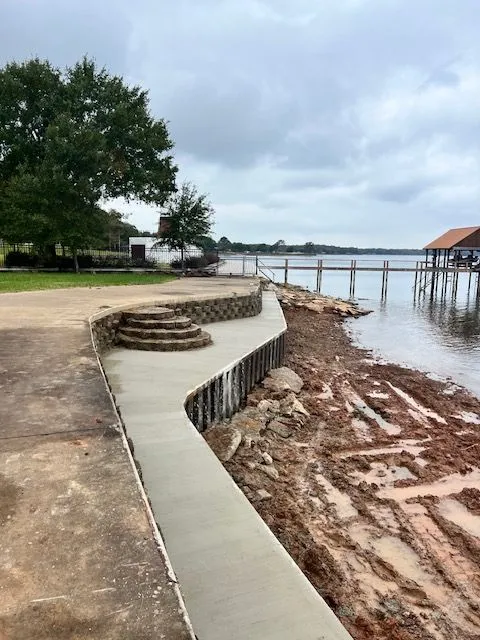
Retaining Walls by Boondock Boatdocks
Durable, Waterfront Retaining Walls Built to Last
At Boondock Boatdocks, we specialize in professionally designed and expertly constructed retaining walls for lakes, ponds, and waterfront properties. Whether you need erosion control, shoreline stabilization, or a structural upgrade to enhance your outdoor space, our retaining walls are engineered to withstand water exposure, soil pressure, and changing weather conditions.
- Superior Shoreline Protection
- Built for Strength & Durability
- Design for Your Property
- Enhances Property Value
Why You Need a Retaining Wall
ON YOUR WATERFRONT PROPERTY
Waterfront properties face unique challenges. Fluctuating water levels, heavy rainfall, and natural soil movement can cause erosion and instability over time. Our retaining walls are designed to:
01.
Prevent shoreline erosion
02.
Protect docks and boat houses
03.
Stabilize sloped terrain
04.
Create level outdoor living spaces
05.
Improve drainage and water flow
06.
Increase long-term property value
When paired with a custom dock system, a retaining wall provides a strong, cohesive foundation for your entire waterfront setup.
The Boondock Boatdocks Difference
When you choose Boondock Boatdocks, you’re working with a team that understands waterfront construction inside and out.
- Experienced in dock and shoreline construction
- Built specifically for lake and pond environments
- Designed for long-term structural integrity
- Customized to your property layout
- Professional installation with quality materials
When you choose Boondock Boatdocks, you’re working with a team that understands waterfront construction inside and out. We don’t believe in one-size-fits-all solutions. Every retaining wall project starts with a detailed site evaluation to ensure the final structure meets both functional and aesthetic goals.
Included in every installation:
Customized drainage systems, Concrete Sea Wall Caps with footings, Grade Work (where applicable).
What are the benefits of having a retaining wall?
Properly installed retaining walls will significantly slow erosion. Soil and sediment makes its way to the shoreline during rains / water events. Retaining walls are intended to slow this naturally occurring process by keeping the sediment / soil behind the wall. Keeping the soil around your building foundation or shoreline is imperative. Excess soil in the lake creates a water depth issue on your shoreline or around your dock. Loosing soil around your building foundation could be the cause of significant foundation failure.
What are your retaining walls made of?
Most retaining walls are made of 8 gauge steel which comes in black (raw) steel or hot dipped galvanized. You may also see concrete walls, block walls, wood walls or PVC walls. Concrete walls are generally higher than steel and water depth can prevent installation. Block walls can be difficult to maintain and flow water can wash out under the blocks. Wood wall are typically cheaper but also have a considerably shorter life span. PVC walls are NOT a new concept. They have been around for years after making their way up from coastal application. It should be noted that in comparison to coastal applications, the inland pvc panel is much thinner and more difficult to be driven into the ground. Additionally, pvc walls commonly use a wood deadman system which will deteriorate much faster than the steel system used with steel panels. Steel retaining wall panels are the most common material used in our area. This is generally due to the fact that the other systems mentioned above either cost more or are comparable to the cost of steel, many applications are not suitable for wall materials other than steel and the overriding longevity that steel wall panels provide. Look around the lake, there is a reason why you see so much steel.
Can we customize the look of the retaining wall?
Walls are easily customized whether you like straight lines or curves or a combination of both. Additionally, you may add beach insets, Jet ski beaches or kayak ramps. However, permitting could limit the scope of creativity.
How do retaining walls vary from seawalls & bulkheads?
Retaining walls are primarily designed to keep soil in. Bulkheads and seawalls, by definition, are designed to keep water out. However it is common that they are referred to as the same.
Are retaining walls bad for the environment?
Environmentally speaking, properly installed retaining walls actually aid our waterways by keeping this from filling up with soil / sediment.
How long do retaining walls last?
For steel walls, each body of water is different. There are 3 forms of corrosion we commonly see on our lakes: Alkaline corrosion, natural-water corrosion and acid corrosion. Given that each body of water has a different ph level, longevity can vary. On Cedar Creek Lake it is commonly said that black steel panels are a 20-25 year panels while galvanized is a 30-40 year panel. On Richalnd Chambers, many black steel panels are still strong at 30 plus years as the deterioration process is much slower on this body of water.
What sort of draining system should be installed with my retaining wall?
In general, waves do not kill walls. Flowing and stagnant water trapped behind a wall is what we believe to be the largest variable in wall longevity. Retaining walls have pipe or pilings driven in the ground usually 10′ or so behind them to provide rigid support using a tie back system. When the ground is saturated the potential for the deadmen to pull forward is significant. Additionally, flowing water or water shed from rains should be vented over the wall or through the wall. We quote drainage systems for all of our walls. Additionally, a properly installed retaining wall sidewalk or seawall cap is vital to protecting the integrity of your wall. Please keep in mind, a standard sidewalk is NOT recommended for your wall cap.
Are retaining walls straight or can they curve with my property?
Retaining walls can be curved, straight or a combination of both. The lay of your shoreline along with permitting requirements are factors that have to be concerned.